EasyDev: Tech Stack Decision Engine
A branching questionnaire that returns scored tech-stack picks across Language, Frontend, Backend, Database, and Infrastructure — with plain-language reasoning and trade-offs.
The Challenge
Junior developers and recent grads face a paralyzing question at the start of every project: what should I build this with? Blog posts go stale, boilerplates hide trade-offs, and hardcoded “use X for Y” advice ignores team size, scale, and constraints.
The Solution
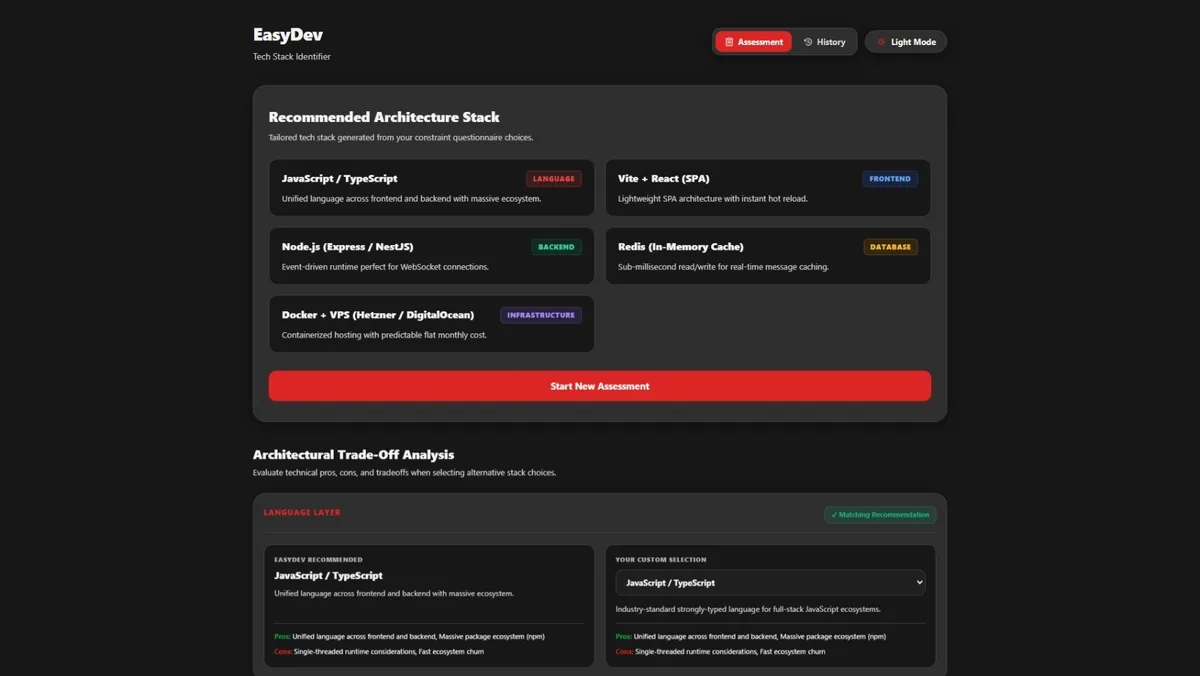
I built EasyDev as a decision engine, not a lookup table. You answer a short branching questionnaire about your project, team, scale, and constraints, and it returns a scored recommendation across five categories — Language, Frontend, Backend, Database, Infrastructure — each with plain-language reasoning and pros/cons. You can also build your own stack manually from the same catalog and compare it against the recommendation.
Live: https://easydev-nine.vercel.app/ Repo: https://github.com/jerohalili/easydev
Technical Highlights
Weighted Scoring, Not If/Else
- Branching question tree: Questions flow via
next_question_id(e.g. “API / Microservice” skips frontend-platform). Multi-select where realistic, with inline contradiction warnings (e.g. realtime + no-backend-logic). - Weighted-sum scoring: Each category scores picks with a
PRIMARY_BOOST x5,SAFE_DEFAULTSon all-zero layers, andneeds_confirmationflags on thin margins. Every pick shows reasoning text + trade-offs. - Seeded catalog: 8 tables (
projects, questions, options, tech_items, weights, answers, results, user_stacks), ~60 options, a weight matrix, and ~30 tech items.
Review → Results → Compare → History
- Review screen: Grouped answer summary; click any row to jump back and edit (forward branch is discarded and rebuilt).
- Compare view: Assemble your own stack from the same catalog and see match/override per category.
- History: Every project and every re-score is preserved (append, not overwrite). Reopen, delete, restart.
Prod-Parity Deployment
- Client: React 19 + Vite + Tailwind v4 with dark/light theme (
data-theme+localStorage) and a resilient fetch helper. - API: Express 5 running as a single Vercel serverless function (
api/index.js), PostgreSQL on Neon viapg(no ORM). vercel.json: Buildsclient/dist, rewrites/api/*to the function, everything else toindex.html.
System Architecture
| Module | Technical Functionality |
|---|---|
| Quiz Engine | Serves branching questions with remaining_steps progress tracking. |
| Scoring Engine | Weighted-sum per category with boost, safe defaults, and thin-margin flags. |
| Comparison View | Manual stack builder backed by the same tech catalog. |
| History Store | Append-only projects + results with full reopen/delete/restart. |
| Theme Engine | Dark/light toggle persisted across sessions. |
Main API Endpoints
| Method | Path | What it does |
|---|---|---|
| GET | /api/health | DB healthcheck (SELECT NOW()) |
| GET / POST | /api/projects | List projects / create {title, description} |
| GET / DELETE | /api/projects/:id | Single project + results / delete (cascades) |
| GET | /api/questions/:id | Quiz step: question + options + remaining_steps |
| POST | /api/projects/:id/answers | Save answers, returns {next_question_id, warnings} |
| POST | /api/projects/:id/score | Run weighted scoring, append result row |
| GET / POST | /api/projects/:id/user-stack | Manual picks catalog / upsert pick |
Impact & Key Takeaways
Moving from Opinion Threads → Scored Decisions gives juniors a defensible starting stack plus the reasoning to change it later.
- Engineering Growth: Designed a data-driven scoring model instead of nested conditionals, and learned to keep one Express app working both locally and as a serverless function.
- Product Insight: Explanations matter more than answers — reasoning text and trade-off analysis are what make a recommendation trustworthy.
Roadmap
- Short-Term: Stricter server validation, restricted CORS, pagination on history.
- Medium-Term: Auth + per-user history with ownership scoping.
- Long-Term: Team workspaces and stack drift tracking as projects grow.
How to Run This Project
Prod parity (client + /api on one port, same as production):
git clone https://github.com/jerohalili/easydev.git
cd easydev
npm run install:all
cp .env.example .env
# set DATABASE_URL (Neon pooled string, sslmode=require)
psql "$DATABASE_URL" -f db/schema.sql
vercel dev
Split local dev (no Vercel account needed):
npm run dev
# API on http://localhost:3001, client on http://localhost:5173